Selected Articles: The Corona War. They’re Coming After Our Thoughts

The Corona War. They’re Coming After Our Thoughts

By Dr. Emanuel Garcia, May 10, 2023

It came to me after a conversation I had with an Australian colleague who has been studying psychoanalytic psychotherapy at an institution in the

The post Selected Articles: The Corona War. They’re Coming After Our Thoughts appeared first on Global Research.

Sudan Talks Held in Saudi Arabia Reveals Underlying Crisis of Governance

All Global Research articles can be read in 51 languages by activating the Translate Website button below the author’s name.

To receive Global Research’s Daily Newsletter (selected articles), click here.

Click the share button above to email/forward this article

The post Sudan Talks Held in Saudi Arabia Reveals Underlying Crisis of Governance appeared first on Global Research.

‘Serious damage, we’re traumatized’ – Sderot man whose home was hit by rocket speaks out

“My wife called me, crying, and said that a rocket had fallen on our house,” said Avi Elkayam. “I rushed home, she said there had been an explosion and she panicked.”

By Lauren Marcus, World Israel News

A man from the southern city of Sderot told Hebrew-language media that his family is seriously considering moving out of the region, after a rocket fired from the Islamic Jihad terror group caused enormous damage to their home.

“The entire garden, pergola, our cars, and living room were totally destroyed,” Avi Elkayam, the owner of the home, told Walla News. “There is serious damage here.”

Elkayam was at work when the rocket struck, he explained. He received a frantic phone call from his terrified wife, who was hunkered down with their children in the home’s bomb shelter.

“She called me, crying, and said that a rocket had fallen on our house. I rushed home, she said there had been an explosion and she panicked.”

Elkayam, who said his family has been living in the city situated less than a mile away from the Gaza Strip for more than 25 years, recalled the trauma of living under rocket fire during previous conflicts.

After so many years of hearing incoming siren alerts and running to their home’s bomb shelter, the family is constantly on edge, waiting for the next volley, he said.

“We get scared by any noise, anything. If the garbage man slams the lid too hard, we get startled,” he told Walla.

“But until now, we didn’t think about it too much. In the past, there were times that rockets fell 200 meters [650 feet] away from our house, but you get used to it.”

However, Elkayam said, the fact that a rocket struck their yard and damaged their home has made them reconsider their commitment to living in the town that they love.

“It’s a small city, like a family, everyone knows everyone,” he said, explaining that despite the benefits of living in the close-knit community, his family is seriously weighing moving out of the area.

He said that his family was “traumatized” from the incident and still planning their next steps.

The post ‘Serious damage, we’re traumatized’ – Sderot man whose home was hit by rocket speaks out appeared first on World Israel News.

‘Scary’ passenger triggers emergency landing on Israel-bound flight

Passenger who cursed, screamed, and threatened to crash the plane forces emergency landing at airport in Madrid; flight eventually continues on to Israel without him.

By Lauren Marcus, World Israel News

An out-of-control passenger who created a major disturbance upon a flight from New York to Tel Aviv forced the plane to make an emergency landing in Madrid, Spain early Thursday morning.

The United Airlines flight departed from Newark Liberty International Airport at 4:35 p.m. on Wednesday afternoon, but a look at an online flight tracker reveals that the plane was diverted from its original course and landed in Madrid at 5:39 a.m. local time, the next day.

The plane then departed for Israel about two hours later, finally arriving at Ben Gurion Airport at 9:55 a.m.

An unnamed passenger reportedly began screaming and cursing, saying that he needed to be able to smoke while aboard the aircraft, and eventually threatened to crash the plane, eyewitnesses told Hebrew language media.

After it was clear that the passenger would not be able to be calmed down, the pilot made the decision to land the plane in Spain.

Media reports did not indicate whether the man was arrested by authorities upon landing in Madrid. The man did disembark from the aircraft and the plane continued on its way to Israel without him.

“There was a passenger who appeared to be haredi [ultra-Orthodox] who went crazy and was acting quite scary,” Yosef, who identified himself as a passenger on the flight, wrote on Twitter.

“The individual sitting next to me was really angry about the situation and started cursing all haredi [Jews], using unpleasant words….but I had seen what was happening, and so did a doctor who was also on the flight. We explained to him that the man’s behavior had nothing to do with religion, and that he had severe mental issues.”

A number of flights to Israel in recent months have been disrupted by unruly passengers.

In late April, an Israeli man on the same United flight from Newark to Tel Aviv engaged in a screaming match with the flight crew.

According to reports, he had sat down in a seat reserved for flight attendants while waiting to use the lavatory. When asked to move from the seat, he allegedly refused and had an intense verbal argument with employees.

Due to the argument, for which United blamed the “disruptive passenger,” the plane turned back towards the U.S. some three hours into the flight.

All passengers aboard the plane were stranded in Newark until the next flight out, a day later.

The post ‘Scary’ passenger triggers emergency landing on Israel-bound flight appeared first on World Israel News.

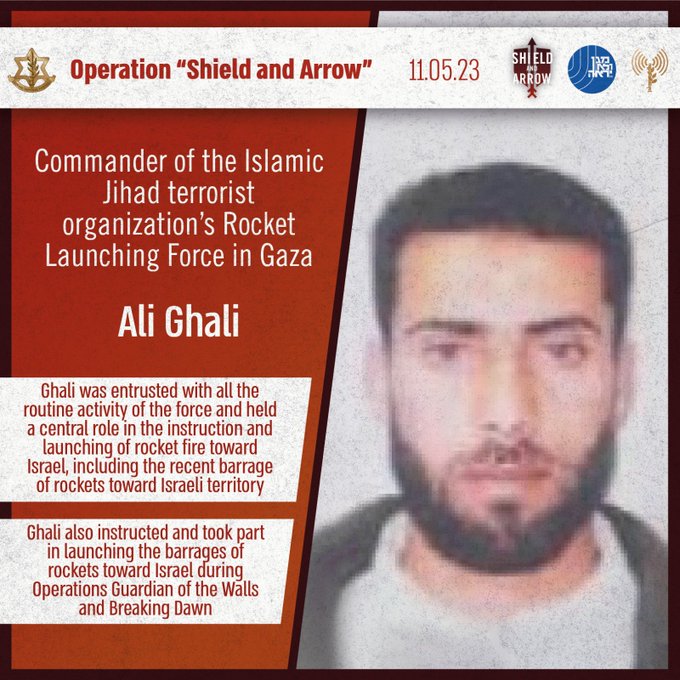
IDF kills commander of Islamic Jihad’s rocket launching force

Rocket attacks on Israel resume after Ali Ghali and two Islamic Jihad operatives in Gaza killed in IDF airstrikes.

By JNS

Around 4 a.m. Thursday morning in Israel, the Israel Defense Forces announced that it had eliminated Ali Ghali, commander of Islamic Jihad’s rocket launching force, as well as two other Islamic Jihad operatives in Gaza.

“Ghali was a central figure in Islamic Jihad, as well as responsible for the recent rocket barrages launched against Israel,” the IDF tweeted.

Ghali was killed in an IDF airstrike while he was hiding in an apartment in Khan Yunis in the southern Gaza Strip. The two other Islamic Jihad terrorists killed in the strike had been hiding in the same apartment.

The killing of the senior Islamic Jihad terrorist marks the fourth prominent member of the group to be eliminated by the IDF in the latest round of fighting.

Ali Ghali, commander of Islamic Jihad rocket force (IDF spokesperson)

“While there have been no rocket alerts for several hours, I expect Islamic Jihad will retaliate for the targeted strike against Ali Ghali and other cadres belonging to the militant group,” Joe Truzman, a research analyst at the Foundation for Defense of Democracies, tweeted.

As of 8:00 a.m. Thursday, the IDF has bombed 147 Islamic Jihad positions in Gaza and shot down 154 rockets since fighting broke out on Tuesday.

A further 110 rocket launches failed to clear the Gaza Strip, with 368 rockets crossing into Israeli territory.

The post IDF kills commander of Islamic Jihad’s rocket launching force appeared first on World Israel News.

Man Brutally Beats 5-Year-Old for Wetting the Bed

A Florida mother’s split-second decision to follow her instincts and check her home cameras likely saved her 5-year-old son from further harm on Wednesday when the footage showed her 32-year-old boyfriend, Shawn Stone, allegedly beating the child as a punishment for wetting his bed.

The child was observed in a fetal position in his bed, begging to stop and pleading for mercy. But Stone wasn’t relenting, allegedly, and he grabbed a mop and hit him with it until the footage stopped.

Upon the police’s arrival at the Deland home, the young boy suffered multiple worrisome injuries: a fractured skull, lacerated lip, bruising on the head, eyes, and face, and a bruise in the shape of a mop handle on the left thigh. Stone attempted to explain away the situation, claiming he had only slapped the 5-year-old’s mouth, but had not assaulted him with the mop. He admitted his “anger got the best of him.”

The woman detailed her boyfriend’s history of drug use, which included a reported past use of methamphetamine. Stone was consequently booked in Volusia County Jail and prosecuted with the offense of aggravated child abuse and a first-degree felony. His long criminal record, which included burglary, armed burglary, and possession of a firearm by a convicted felon, was also brought to light.

Heroes and Anti-Heroes: A Teachable Moment for the Next Generation

Hollywood continues to thrill and entertain us with new adventures of people with superpowers.  However, many of these new characters are not virtuous heroes but rather anti-heroes such as DC’s Black Adam and Marvel’s Deadpool. With the lines between good and evil portrayed as ever blurrier, distinguishing heroes, villains, and anti-heroes is critical for warriors and our society at large.

What is a hero?  A hero is someone who fights against something larger than himself for something larger than himself.  The young shepherd and future King of Israel, David, epitomizes heroism.  He was morally outraged by the blasphemous insults of pagan Goliath, who mocked the living God.  The Bible is full of examples of those who rose to the occasion during crises: Deborah, Ehud, Gideon, and Abram who armed his household to pursue the enemy and rescue Lot.  Historical figures such as the Continental Army at Valley Forge and the defenders of the Alamo, as well as fictional figures such Harry Potter, Frodo Baggins, and Narnia’s Pevensie are heroes as well.  A hero is often made by being in the right place—or rather, the wrong place—at the right time.  

Because heroism is the struggle for something larger than oneself against the odds, we often use the term “heroic” or “heroism” for people facing injustice or evil far from the battlefield.  Political leaders may be heroic in standing firm during national crises, as Churchill and Lincoln did.  Martin Luther King, Jr. was heroic in confronting the violence of institutionalized prejudice.  Corrie Ten Boom’s family and all the others who hid Jews from the Nazis were heroic.  

The single parent working two jobs, the cancer survivor, the veteran amputee returning to civilian life, the advocate fighting against the odds on behalf of the vulnerable demonstrate heroism as well.  Heroism is about the moral quality of the action, not the amount of power at one’s disposal.  

Hollywood’s villains use the power at their disposal to deliberately harm others, such as the Wicked Witch of the West in The Wizard of Oz or Superman’s nemesis Lex Luther.  Heroes, in contrast, understand that with “great power comes great responsibility.”  Some fictional heroes have extra-ordinary powers, “superpowers,” such as Wonder Woman and Spiderman.  Others exercise power inherent in their position or office, such as Star Trek’s Captain James T. Kirk with his mighty USS Enterprise.  Heroes make the moral choice to use the resources at their disposal on behalf of the common good.  

In stark contrast is the anti-hero.  This is the individual who has power but does not consistently direct his or her will toward or against the common good, but rather wields power selfishly. The anti-hero acts on self-interest or a moment’s whim.  That whim might appear compassionate or vindictive, protective or destructive.  Consider the difference between the typical John Wayne Western hero, who protects and defends the weak from predatory criminals, to Wayne’s drunken Rooster Cogburn in True Grit.  Anti-heroes on the screen include Tony Soprano, Clint Eastwood’s “man with no name,” Deadpool, Captain Jack Sparrow, DC’s Black Adam and Marvel’s Loki, among many others.  

The Bible has its own anti-heroes, such as Samson, who was so often led by his appetites.  Our classical literature has anti-heroes, such as the notorious Achilles of the Iliad.  Though Achilles was the mightiest warrior of his age, he was seized by his passions — vengeful anger, lust, petulance — and he acted as a law unto himself. The anti-hero may act as the good guy in one situation but is the villain in the next.  The anti-hero has power but shuns responsibility.  He is untrustworthy, self-seeking, and intemperate.

We live in a society where self-gratification is increasingly glorified.  We see this in the angry ranting of social media, where one has a “right” to say whatever one wants.  We see this in the ongoing sexual revolution, where public displays are not just a fundamental right but some perverse form of responsibility.  And we see it in the anti-hero, who whimsically uses power without a moral center to guide that action.  

The problem is that we cannot assume that power and virtue necessarily go together in the latest Hollywood blockbuster. But Christians know that motives matter and that Jesus taught us love of God and love of neighbor.  That is a pretty good start for evaluating the moral fabric of people like Captain America and King Arthur: are their exploits motivated by love of neighbor?

Why does this matter?  One reason can be found in a concern that military leaders have been voicing for the past twenty years.  The concern is that young citizens that join the military at age 18 do not come with a shared moral framework and a consistent set of ethical guide rails.  Eric Wester chronicles this in a chapter on character development in my edited volume, Military Chaplains in Iraq, Afghanistan and Beyond.  Judeo-Christian norms of honesty, moral courage, and neighbor-love should undergird our services’ core values, such as “Integrity, Service, Excellence” (U.S. Air Force) and “Honor, Courage, Commitment” (U.S. Navy).  But, as Wester notes, an ethic of “don’t narc” (do not betray a comrade, even if they have done wrong) and “live and let live” has permeated our culture.  In a world where there are no longer absolutes, from high school testing outcomes to one’s imagined identity, the military cannot rely on the citizenry to provide young people with a shared commitment to fundamental moral precepts such as do not lie or cheat.

This is why thinking about heroes is so important.  A bridge to our young people is to look for the better myths of our time, such as the last act of Tony Stark’s Ironman character, when he selflessly gave his life to defeat evil.  What a contrast to the self-aggrandizement of Captain Jack Sparrow or the destructive hatred of Black Adam!  We can point our youth to our military heroes, from George Washington to Sergeant Alvin York, our literary heroes such as Aragorn and King Arthur, and Biblical heroes such as Joshua, David, and Nehemiah.  The Bible provides many other heroic acts, such as the Hebrew midwives who deceived Pharaoh to save Jewish babies and the three Hebrew ‘children’ who faced the fiery furnace because they refused to bow to an idol.  Thus, we must not glorify the anti-heroes, much less the villains, of our twisted times, but, rather, focus the attention of our young people on the conviction, courage, and toughness of real heroes.

The post <strong>Heroes and Anti-Heroes: A Teachable Moment for the Next Generation</strong> appeared first on Providence.
Rex 84: FEMA’s Blueprint for Martial Law in America

We are dangerously close to a situation where ~ if the American people took to the streets in righteous indignation or if there were another 9/11 ~ a mechanism for martial law could be quickly implemented and carried out under REX 84.

The post Rex 84: FEMA’s Blueprint for Martial Law in America appeared first on Global Research.